2025 Trans-Tasman Travelling Fellow Report
Adrian Talia, VIC
Adrian Talia took part in the Trans-Tasman Travelling Fellowship in 2025. Here he writes on the places he visited and valuable experience gained from attending the AOA-NZOA combined Annual Scientific Meeting in Queenstown, New Zealand.
I had the privilege of attending the Australian Orthopaedic Association (AOA) and New Zealand Orthopaedic Association (NZOA) combined Annual Scientific Meeting, held in Queenstown, New Zealand, in October 2025, as the AOA Trans-Tasman Travelling Fellow. This fellowship was kindly supported by AOA, and I am grateful for the opportunity to represent our Association and engage with colleagues from across Australasia and beyond.
The meeting took place at the Queenstown Memorial Hall, framed by the stunning Remarkables mountain range and Lake Wakatipu. Spanning three days, the program delivered a comprehensive blend of educational sessions, subspecialty symposia, plenary lectures, bringing together delegates from Australia, New Zealand, the United Kingdom, North America, and the Asia-Pacific region.
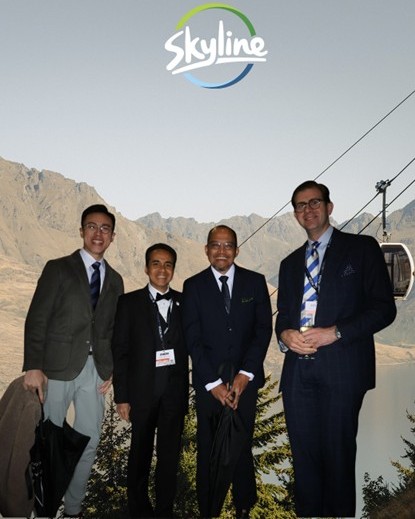
Adrian with other travelling fellows from Hong Kong, Indonesia and the Philippines.
Scientific program and theme
The 2025 theme, ‘Complications and complaints in Orthopaedics’, captured the shared commitment to advancing surgical practice through research, technology, and partnership.
The combined Presidential session highlighted ongoing challenges in regional healthcare delivery and workforce planning, while also addressing the integration of artificial intelligence, robotics, and data-driven decision-making into clinical orthopaedics. Given some recent experiences in my practice, the theme of complaints and complications resonated personally with me. A talk from former professional rugby player and cancer survivor Nick Petrie on how to deal with complications and stress gave me some practical tips to take home to deal with significant stressors in my practice.
The scientific program was broad and engaging, with strong representation across trauma, arthroplasty, spine, upper limb, and foot and ankle surgery. Sessions in foot and ankle and orthopaedic trauma, my areas of clinical interest, were particularly relevant, showcasing emerging approaches to syndesmotic injury management, complex hindfoot reconstruction, and biologic adjuncts for fracture healing. Being able to listen to orthopaedic living legends such as Paul Tornetta III talk on his experience treating ankle fractures and dealing with surgeon incompetence was a particular highlight of the scientific programme.
I was given the opportunity to present my research, 'Gender differences in foot and ankle sports injury rates in elite athletes: Systematic review and meta-analysis of 25,687,866 athlete-exposures'. The presentation prompted some discussion regarding sex-specific risk factors in athletic injury patterns, preventative strategies, and implications for elite sports medicine and surgical management. The feedback and engagement from the audience were exceptional, reinforcing the importance of ongoing collaboration between sports physicians, orthopaedic surgeons, and rehabilitation specialists.
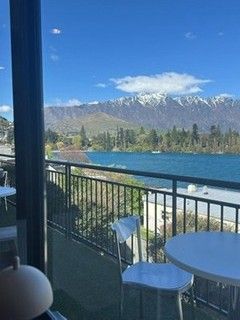
The Remarkables mountain range.
Fellowship experience
Beyond the formal sessions, the travelling fellowship offered rich opportunities for professional exchange and networking. Conversations with colleagues and mentors across both associations revealed shared priorities around training pathways, research collaboration, and innovation in surgical education. The collegial atmosphere and open sharing of ideas were emblematic of the enduring Trans-Tasman partnership. It was great to see strong Australian representation across many of the sessions during the meeting.
The industry exhibition hall also stood out, featuring both established technologies and novel innovations in orthopaedic implants, intraoperative navigation, and sustainable manufacturing practices. Of particular interest were the demonstrations of advanced fixation systems for foot and ankle trauma, highlighting how design evolution continues to refine operative precision and patient outcomes.
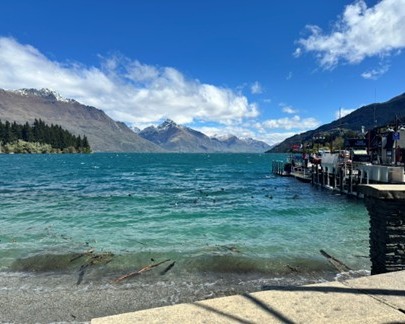
Lake Wakatipu.
Social and cultural highlights
The social program was equally memorable. The Presidents’ Reception at the Skyline complex offered breathtaking views over Queenstown and Lake Wakatipu, setting a perfect tone for the week. The Monday evening Gala Dinner, held at Stratosphere Restaurant overlooking the city (through the heavy rain), provided an evening of warmth and camaraderie, underlining the friendship and shared values that unite AOA and NZOA. It was a pleasure to sit next to the other travelling fellows and hear about their stories. A visit from NZ royalty in the form of All-Black rugby union players was a highlight for the locals – although I must say I was a bit lost amongst all of their ’inside jokes’ and the surgeons recounting where they were when the All Blacks won the 2011 world cup.
I took the opportunity during some quiet time for a stroll down the main street of Queenstown, treating myself to a famous ‘Ferg Burger’, and sitting at the wharf eating lunch, with a view of the beautiful lake and snow-capped mountain range provided a great chance to reflect and take in the surrounds.
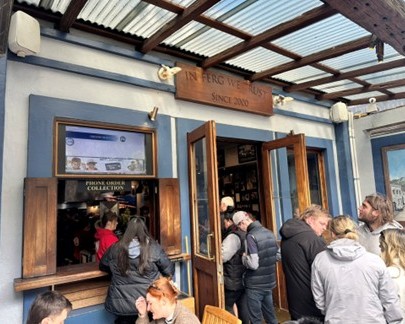
The famous ‘Ferg Burger'.
Reflections and acknowledgments
The Queenstown meeting was a celebration of collaboration, innovation, and professional growth. AOA and NZOA continue to demonstrate exemplary leadership in fostering academic exchange and advancing orthopaedic care across the region.
I extend my sincere thanks to the Australian Orthopaedic Association for their generous sponsorship of my trip and to the New Zealand Orthopaedic Association and organising committee for their outstanding hospitality. Participating as the Trans-Tasman Fellow was an honour.