NAIDOC (National Aborigines and Islanders Day Observance Committee) Week is celebrated across Australia each July, recognising and celebrating the rich history, cultures, achievements, and enduring contributions of Aboriginal and Torres Strait Islander peoples.
The 2026 theme, '50 Years of Deadly', pays tribute to those that built the NAIDOC movement; the stories, the marches, the languages, the art, and the leadership. It looks to the next 50 years and the strengthening of language, the connection to country, and the continued fight for justice.
For AOA, NAIDOC Week is also an opportunity to reflect on how we can continue strengthening relationships with Aboriginal and Torres Strait Islander peoples, improve health outcomes, and contribute to a healthcare system that is culturally responsive, inclusive and equitable.
Paralpi by Zaachariaha Fielding was chosen as the official poster for NAIDOC Week 2026. Fielding is a proud Yankunytjatjara man from the APY (Aṉangu Pitjantjatjara Yankunytjatjara) Lands in South Australia. Spanning roughly 103,000 square kilometres, these lands are collectively owned by the traditional Aboriginal owners, the Aṉangu people.
Read the reflections below from AOA members and staff as they share what NAIDOC Week means to them and why this year's theme is significant.
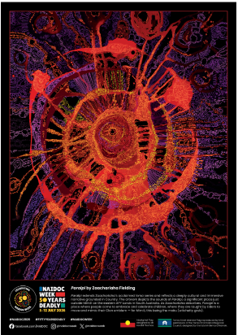
Paralpi by Zaachariaha Fielding, the 2026 National NAIDOC Poster incorporating the Aboriginal Flag and the Torres Strait Islander Flag (licensed by the Torres Strait Council)
50 years of Deadly: more than a celebration
Damien House
AOA Aboriginal and Torres Strait Islander Peoples’ Manager
NAIDOC Week provides an opportunity for all Australians to recognise the histories, cultures, achievements, and enduring strength of Aboriginal and Torres Strait Islander peoples. In 2026, the theme '50 Years of Deadly' marks an important milestone, commemorating five decades of NAIDOC Week as a national platform for Aboriginal and Torres Strait Islander voices, leadership and advocacy.
The word 'deadly' means excellence, strength and pride. It celebrates achievement, resilience and survival. Yet as we mark 50 years of NAIDOC, it is worth asking a more challenging question? After 50 years of raising awareness, what has changed, and where have we fallen short?
The history of Aboriginal and Torres Strait Islander peoples did not begin 50 years ago. Our cultures, languages and knowledge systems represent the oldest continuing cultures on earth. NAIDOC Week does not celebrate the beginning of our story. It celebrates 50 years of a national movement that has sought to ensure our stories, voices and aspirations are heard. While NAIDOC marks fifty years of advocacy and recognition, the cultures it celebrates have endured for tens of thousands of years. Long before the rise of ancient civilisations, before the construction of the pyramids, and before many of the world's oldest written languages emerged, Aboriginal and Torres Strait Islander peoples were living on, caring for, and sharing knowledge across this continent we now call Australia.
Over those five decades there has been meaningful progress. More Aboriginal and Torres Strait Islander people are represented in leadership, education, healthcare, and public life than ever before. Conversations about cultural safety, reconciliation and equity have become part of the national dialogue.
Yet progress alone is not enough.
The Voice referendum and the conversations that followed demonstrated that recognition remains a complex and contested issue in Australia. Misconceptions also persist. Many Australians still believe Aboriginal and Torres Strait Islander peoples receive advantages unavailable to others, despite ongoing disparities in health, education and social outcomes.
These realities remind us that awareness alone does not create change. Understanding must lead to action, and recognition must be matched by accountability. After 50 years, the challenge is not whether Australians have heard the message. The challenge is what we choose to do with it.
For those of us working in healthcare, NAIDOC Week provides an opportunity to reflect on our role in shaping that change. Health outcomes are influenced not only by medicine and surgery, but by trust, relationships, access, cultural safety, and whether people feel respected by the systems designed to care for them. If we are serious about improving outcomes, we must be prepared to examine not only what we do well, but also where our systems continue to fall short.
Within orthopaedics, our responsibility extends beyond treating injuries and restoring function. We must continue striving to create environments where Aboriginal and Torres Strait Islander patients, families and communities feel safe, heard and respected. Cultural safety is not a destination. It is an ongoing commitment to listening, learning and reflecting on how our systems and practices affect those we serve.
The Australian Orthopaedic Association has taken important steps in strengthening its focus on cultural safety, Indigenous health and meaningful engagement with Aboriginal and Torres Strait Islander peoples. These efforts matter because improving outcomes requires more than good intentions. It requires accountability, partnership and a willingness to learn from both successes and shortcomings. The measure of success is not the number of initiatives we undertake, but whether Aboriginal and Torres Strait Islander patients experience better care and better health outcomes as a result.
Education remains one of the most powerful tools available to us. It challenges assumptions, builds cultural intelligence, strengthens relationships, and creates opportunities for meaningful change. Whether through formal learning, engagement with communities, or reflection on our own practice, each of us has a role in helping create a healthcare system where Aboriginal and Torres Strait Islander peoples experience better outcomes.
As we mark 50 years of Deadly, we should celebrate the achievements of those who came before us. We should recognise the Elders, advocates, educators, health professionals and community leaders whose efforts helped build the movement we know today. But we should also be honest about the work that remains.
The next 50 years cannot simply be about repeating the conversations of the last 50. They must be defined by action, accountability and outcomes. Progress should not be measured by the number of welcomes to or acknowledgements of country we deliver, but by whether Aboriginal and Torres Strait Islander peoples experience better health, greater opportunity and a stronger voice in the decisions that affect their lives.
50 years of Deadly honours those who carried the movement to this point. The responsibility for the next fifty years belongs to all of us.
Prof Ian Incoll
Conjoint professor Faculty of Medicine and Public Health, University of Newcastle, Australia
At the 2026 Emerging Leader Forum, Ian reminded delegates and faculty "that the simple act of recognising the at least 65,000 years of continuous connection, communication and sustainability is important. Newer Australians have so much to learn…".
Andrew Wines AM
AOA Vice-President
The concept of Dadirri was presented to delegates at the recent AOA Emerging Leaders Forum by Professor Ian Incoll.
Dadirri is the practice of deep inner listening and quiet still awareness. It is Aboriginal knowledge from the Ngan’gikurunggurr people of the Daly River region and has been generously shared more broadly by Dr Miriam Rose Ungunmerr Baumann.
Dadirri invites us to slow down, listen deeply and develop greater awareness of ourselves, others, and our connection to the world around us. It recognises that silence is not empty, but can be an important space where understanding, reflection and wisdom can emerge.
Learning from the principles of Dadirri encourages:
- Deep listening: hearing not only the words spoken, but also emotions, experiences, intentions and what may remain unspoken.
- Stillness: valuing quietness and silence rather than feeling the need to immediately respond or fill the space with words.
- Respect: approaching every individual with openness, humility and without judgement.
- Patience: allowing understanding and relationships to develop over time rather than rushing towards immediate answers or action.
- Connection: recognising the importance of relationships between people, Country, ancestors, family and community.
- Reflection: creating time for contemplation before responding, deciding or acting.
Professor Incoll reflected on the importance of Dadirri and how its principles can inform leadership, relationships and the way we engage with others. These teachings encourage us to consider how we listen to our family, friends, colleagues, trainees and patients.
There are also connections between Dadirri, and approaches used in areas such as crisis support, where deep listening, allowing silence, reflection, empowerment and acceptance are recognised as important elements of supporting others. However, Dadirri extends beyond listening as a communication skill. It reflects a broader Aboriginal knowledge system grounded in relationships, connection and understanding.
NAIDOC Week provides an opportunity to acknowledge and respect Aboriginal and Torres Strait Islander knowledge systems and to reflect on the importance of listening, connection and relationships in our own lives and professional practice.
Through learning from Dadirri, we are reminded that sometimes the greatest understanding comes not from speaking first, but from creating the space to truly listen.
Watch and listen to Dr Miriam-Rose Ungunmerr's short film 'Dadirri — A Gift To The Nation'.
Walking Together
Susi Tegen
Chief Executive National Rural Health Alliance
My journey and my experiences have been shaped through friendships whilst living in Alice Springs and Darwin, through the relationships I have developed with my work and life.
I have Indigenous friends, but I still have much to learn, I have lived and worked in Mparntwe/Alice Springs which is the land of the Arrernte people.
As I write this, I sit at my desk beneath an Indigenous painting that was given to me in the early 1980s by an Indigenous artist and friend whilst living in the Northern Territory.
It reminds me every day of that time in my life and the relationships I formed and the time spent living.
As an immigrant to Australia, living in the Northern Territory opened my world to new smells, new bird and animal sounds, the smells of nature, the red soil, and the reminder of the Todd River flooding within a very short period. It was also about the many languages from all over the world and the various Indigenous languages.
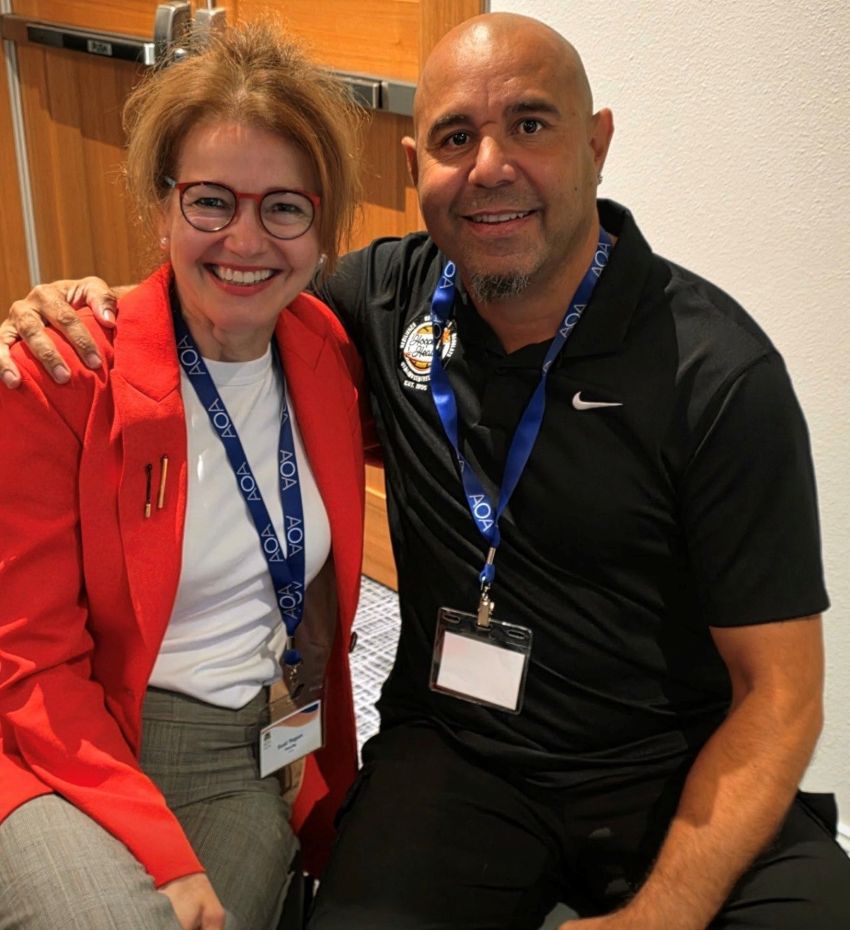
Chief Executive National Rural Health Alliance Susi Tegen with Founder Hoops 4 Health Timmy Duggan.
I met and befriended amazing people from all walks of life, including Indigenous people. I learned of their connection to land, and while I do not directly understand it, I value the connection to where you are from and how a person's five senses, and perhaps even their soul, never forget it. It is hard to explain.
NAIDOC Week, for me, is a time of reflection, recognition and celebration, an opportunity for Australians to honour the history, culture, resilience and achievements of Aboriginal and Torres Strait Islander peoples.
While it is often politicised, I try not to focus on this. I try to focus on what I can do for all people within my circle of influence, for those I work with, and in my daily work and social life. Indeed, I think about what I can do through any policy I can influence.
Held each July, the NAIDOC Week theme, ‘50 Years of Deadly’, brings communities together to acknowledge the stories, leadership, traditions, art and contributions that have shaped Australia and who we are today. Above all, it reminds me to reflect on what I can learn and the assumptions I may hold.
I think about progress, working together, and the five decades of the NAIDOC movement. I also reflect on the courage people have shown along the way to stand up and seek equal treatment and better health outcomes.
The theme pays tribute to the people who built courage, advocacy and leadership at the grassroots level, recognising the marches, languages, art, stories and community voices that have carried NAIDOC forward. It also invites everyone to look ahead and consider how we continue building a more respectful, inclusive and connected future.
For me, participating in AOA's NAIDOC Week campaign is an opportunity to reflect on a journey shaped by listening, learning and a deep commitment to walking alongside Aboriginal and Torres Strait Islander peoples and communities.
My journey has reinforced the importance of approaching NAIDOC Week as a time for reflection and humility. The most important thing is to listen, which often requires time, and to make that time in a very hectic world, not because it is politically correct, but because it is the right thing to do.
For more information and resources, visit the
NAIDOC website.